WRITTEN FIELD PROJECTS:

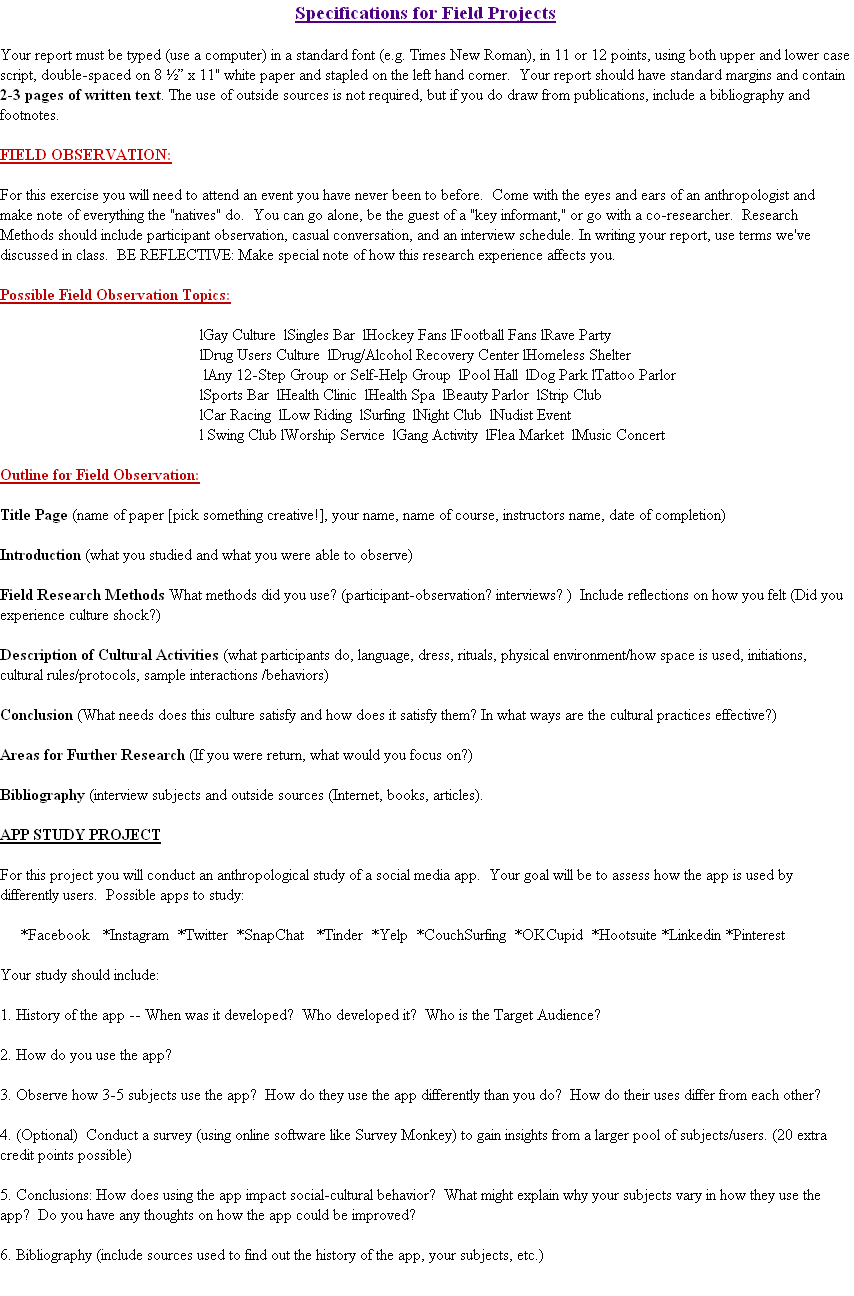
For this assignment you will go out in the cultural field (of Southern California) and do either a 1) field observation or a 2) life history interview.

Specifications for Field Projects

wpd07eb079.png
2.  Intercultural/interethnic experiences.
3.  Cultural identity, values and customs: How does the subject define their ethnic community?
4.  Experiences living in Southern California.
5.  Issues regarding intergenerational conflict experienced by the interviewee.  
6.   Migration experiences and experiences with learning a second language.
RESEARCH PAPER

You have three options for a research (term) paper:
1) A Field Ethnography  
2) A Comparative Analysis of Two or More Ethnographies  
3) Your Own Research Inspired by an Ethnography

Specifications for Field Research Paper:

Your report must be typed on a computer, double-spaced on 8 ½” x 11" white paper using a standard font (e.g. Times New Roman) in 11 or 12 points and stapled on the upper left corner.  Your report should have standard margins and 6-7 pages of typewritten text.  If you choose, you can illustrate your report with photographs, graphs, charts, and/or drawings.  Groups of up to four people can produce a single research paper.  Such papers should be 9-10 pages in length, reflecting the research experience of each member.

1. A Field Ethnography (detailed description of a culture).  
Here, you can continue the research you began with your FIELD OBSERVATION by visiting your cultural setting at least four more times.

In preparing your ethnography you will need to study the rules, behaviors, rituals, language and interactions of your subject group.  I suggest you keep a field journal to help you remember the things you observed in the field.  Here you can record what you see, your impressions, experiences, and detailed observations.  Preparing an ethnography can be an extremely rewarding experience--you will acquire skills in observing human social behavior and gain self awareness by being an insider/outsider.  You can supplement your written report with video recordings/photographs that you personally produce and/or shoot.

Expand from your FIELD OBSERVATION by including some interpretations/ comparisons gathered from at least one outside (e.g. library or Internet) source.  Make sure to footnote your references to this source.  End your report with a bibliography (format on last page)  

Outline for Field Ethnography

Title Page (name of paper [pick something creative!], your name, name of course, instructors name, date of completion)

Introduction (what you studied and what may be unique about your report)

Field Research Methods What methods did you use? (Consider drawing from a variety of methods including participant-observation, interviews, surveys, questionnaires, etc.)   Include reflections on your feelings changed as you further explored your subject/culture.

Description of Cultural Activities (what participants do, language, dress, rituals, physical environment/how space is used, initiations, cultural rules/protocols, sample interactions /behaviors)  In this section you might include photographs, drawings, and charts that you have created.

Comparison/Analysis (Consider the findings of others who have studied this cultural scene--be sure to footnote your references!)

Conclusion (What needs are satisfied?  Relative your additional observations and comparisons, in what ways are the cultural practices effective?)

Areas for Further Research (With sufficient finances and time, what aspects of this culture do you think merit further investigation?)

Bibliography (Include names of interview subjects, web sites, books, and journal articles)

2. Comparative Analysis of Two or More Ethnographies
Read two ethnographies. Compare and contrast the anthropologists' research methods, findings, and conclusions.  Possible comparisons might be:

The Kung (two perspectives)
(Nisa: The Life and Words of a Kung Woman and The Dobe Ju/'hoansi)

The African American Experience
(Tally's Corner, All Our Kin, and Hustling and Other Hard Work)

The American Working Class Experience
(Families on the Faultline and Urban Survival)

The Yanomamo (two perspectives)
(Yanomamo and Into the Heart)

Italian Men vs. Italian Women
(The Broken Fountain and Women of the Shadows)

Alternative Genders
(Neither Man nor Woman and The Spirit and the Flesh)

Outline for Comparative Analysis

Title Page -- name of paper (pick something creative!), your name, name of course, instructor's name, date of completion

Introduction -- include authors' name, book titles, years of publication, and a brief overview of each book.

Compare and contrast the authors' field research experiences and methods (Where did they go, who did they study, what methods did they use to gather their findings?  How were their methods similar? different?)

Compare and contrast each authors' findings -- Include what impressed you the most such as new ideas and new ways of seeing things.

Your assessment of areas for further research
(What more could be said/studied about this culture?)

Bibliography--Use the format specified on the last page.


3. Your Own Research Inspired by an Ethnography
Read an ethnography and follow up on one or more of the topics the author explores.  Your research can include interviews, surveys, participant observation, and certainly additional library research.  Possible topics might be:

Single Women/Men in Los Angeles
(Women Who May Never Marry)

Working Parents
(The Second Shift)

Street Corner Men
(Tally's Corner)

The Bar Scene
(Cocktail Waitress: Women's Work in a Man's World)

The Elderly
(Number Our Days)

Undocumented Immigrants
(Shadowed Lives)

Outline for Your Own Research Inspired by an Ethnography

Title Page -- name of paper (pick something creative!), your name, name of course, instructor's name, date of completion

Introduction -- include authors' name, book title, year of publication, and a brief discussion of the area that you decided to investigate.

Field Research Methods -- What methods did you use? (Participant-observation? Interviews?  Surveys?)  Are your methods similar to those used by the author?

Your Findings -- Describe your discoveries.  It is best to discuss your findings by separating them into subtopics.

Conclusion -- (Summary of your findings)

Areas for Further Research -- (With more time and funds, what else would you study?

Appendix -- Charts/graphs, Copy of questionnaires, Interview schedules, etc.

Bibliography – Use a standard format.